Wednesday, July 31, 2013
Book Review: Purple Hibiscus by Chimamanda Ngozi Adichie
I reviewed Adichie's second novel, Half of a Yellow Sun, last year when I was working at the BAM book/merch kiosk (review HERE). I picked it up on one of those days when I was working a double and had finished the book I was reading and needed something to pass the time. As you can see from my review, I fell in love with the story and her prose, and couldn't wait to read her first novel and her collection of short stories. It took me a year to get back to her, because I am terrible with keeping up to date on my reading lists (if you saw the pile of books waiting to be read next to my bed you would understand), and because I only remembered to buy her first novel, Purple Hibiscus, when I read a review on the release of her third novel, Americanah.
I don't usually start a book with the feeling that it may not be as good as I am hoping it to be, but I did with this one, seeing as I had read her second novel before her first, and how much of a mark it had left on my brain and my heart. I couldn't have been more wrong. Adichie had definitely already found her voice before she started writing Purple Hibiscus, and the prose is just as stunning and sublime as it was in Half of a Yellow Sun. From here on out I shall stop comparing, as although both novels are set in Nigeria, that is where the resemblances end.
Purple Hibiscus is set in post-colonial Nigeria, and revolves around the home of Kambili, the narrator, a quiet, shy and studious 15 year old girl, her older brother Jaja, her father Eugene and her mother Beatrice. With the backdrop of a military coup and military crackdowns and the beginnings of uprisings in the country, we see Kambili's small world grow while she herself comes to terms with her problems at home, and those of the country she lives in. Eugene is wealthy and well-respected in the community, aiming to give his family the best education and life that he can, as well as helping those around him. But he is also a religious zealot and a tyrant at home, with a violent temper and prone to doling out harrowing punishments that make your heart hurt. When Eugene's sister, Ifeoma, persuades him to let her take Kambili and Jaja to stay with her in her town for a week, the children both learn of a world outside of theirs that is bigger and more complicated than they can ever expect, which in turn leads them both to question their own lives and how their father wants them to live them.
At times beautiful, at times horrific, Purple Hibiscus draws you into a world that is so different, but at the same time so similar, and wraps itself around you tightly. Once you have Kambili's voice inside your head you are loathe to let her go, even after you have turned the last page and there are no more words. There are times where I just wanted to shake her and say "speak up, let your voice be heard!", and then would remember myself at her age, and how I often found it impossible to say anything out of fear of being heard. I love Adichie's character development skills - her characters are always so real and so human, never black or white or one-sided, but colourful and full of emotion. This novel is so harrowing and so beautiful it will remain with you well after you have finished it.
After chatting to one of my friends about how I loved Chimamanda Ngozi Adichie's work last night, she sent me an interview she had come across not so long ago in the New York Times. I can't wait to read Americanah (and will do once it is out in paperback - I find hardbacks too heavy to carry around and too annoying to bulky in bed), and this interview just really emphasized why I love this amazingly talented author so much.
Saturday, March 2, 2013
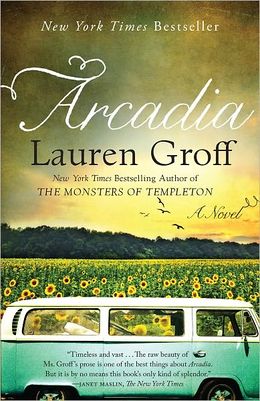
Book Review - Arcadia by Lauren Groff
There are times when I start to read a novel and by the first sentence I am completely hooked, reluctant to put it down and always thinking about the next moment that I will have a free minute so that I can pick it up again and continue to read the story. There are other times when I read a few pages and lose interest, dropping it down on the pile of books on my nightstand, sometimes going back to it on another day, other times just leaving it there until it makes it's way back into one of my book cases. And then there are the times that I start a book, and have a little trouble in the beginning, but keep at it, because I know deep down that it is going to be a gem of a story, one that will hold onto my heart for a long time. Arcadia by Lauren Groff falls into the latter category.
Set in three different periods of time, Arcadia follows little Bit's life, from when he is born into a commune named Arcadia in the late 60's, through his early 30's in New York City and then finally back in Arcadia in his 50's. Born to Abe, a pillar of the Arcadian community, and Hannah, strong and beautiful but prone to bouts of debilitating depression, the only life Bit knows until his early teens is that of Arcadia. A commune based on utopia ideals that works and then falls apart, where everyone works together to create a place where the rules of the outside world are not needed in order to survive. Where music and love and hard work create a home where happiness is meant to be prevalent, and politics, hypocrisy and hatred are non-existent. Arcadia works well in a confined place with a small amount of inhabitants but once it becomes popular the population grows and grows, and the ideals inevitably start to crumble. We see Arcadia through Bit's eyes and hear it's music through Bit's ears, we become part of his life, ask the same questions as him, love his friends the way he loves them and fall in love with the troubled Helle, the girl and then woman who occupies his heart even when he doesn't want her to, when he does. When Arcadia falls apart Abe and Hannah decide to take their son out into the world, before they are crushed by the consequences, and Bit has to learn how to live as most people live, away from the protection of the commune and from the freedom he always knew.
Groff's prose is absolutely beautiful. Her descriptions of Arcadia are stunning and so realistic you can only imagine being there; however, it is the way that she portrays love, heartbreak and pure sadness that really hit me in the stomach. We all know these feelings all too well, but when the prose you are reading actually makes you feel the exact emotions the main character is feeling, down to the very core, something special happens. It's as if it releases something inside of you, a mixture of pure sadness and the realization that you have touched something very beautiful and very clear. I hope that one day my own writing can create the same type of feeling in others, because there is something so incredible about how this type of writing continues to make you feel, days after you have finished the book. Groff has an amazing talent, and I hope she continues to create such wonderful stories for us.
Arcadia is not only a terrific story in itself, it is also, in my opinion, a stunning piece of literature.
Lauren Groff's Website
Tuesday, February 19, 2013
Album Review: Nick Cave & The Bad Seeds - Push The Sky Away
Anyone who knows me, or even anyone who doesn’t really know me but reads this blog has to understand how much I absolutely love and adore Nick Cave. Nick Cave the musician, the writer, the actor, the poet, Nick Cave & The Bad Seeds, Grinderman, The Birthday Party… I feel like I have spent most of my life listening to Nick Cave, reading Nick Cave, seeing Nick Cave in concert and so forth. I literally wait for every new album with baited breath, knowing full well that I will never be disappointed. Granted, there are a few albums that I listen to less than others, but I’ve never disliked anything that he and the Bad Seeds have ever produced.
Sunday, December 30, 2012
Ramblings: The end of 2012 (and the beginning of 2013)
Monday, September 24, 2012
Book Review: The Marriage Plot by Jeffrey Eugenides
"To start with, look at all the books. There were her Edith Wharton novels, arranged not by title but date of publication; there was the complete Modern Library set of Henry James, a gift from her father on her twenty-first birthday; there were the dog-eared paperbacks assigned in her college courses, a lot of Dickens, a dmidgen of Trollope, along with good helpings of Austen, George Eliot, and the redoutable Brontë sisters. There were a whole lot of black-and-white New Directions paperbacks, mostly poetry by people like H.D. or Denise Levertov. There were the Colette novels she read on the sly. There was the first edition of Couples, belonging to her mother, which Madeleine had surreptitiously dipped into back in sixth grade and which she was using now to provide textual support in her English honors thesis on the marriage plot. There was, in short, this mid-size but still portable library representing pretty much everything Madeleine had read in college, a collection of texts, seemingly chosen at random, whose focus slowly narrowed, like a personality test, a sophisticated one you couldn't trick by anticipating the implications of its questions and finally got so lost in that your only recourse was to answer the simple truth. And then you waited for the result, hoping for "Artistic" or "Passionate", thinking that you could live with "Sensitive", secretly fearing "Narcissistic" and "Domestic", but finally being presented with an outcome that cut both ways and made you feel different depending on the day, the hour, or the guy you happened to be dating: "Incurably Romantic."
I already identified with Madeleine from the first lines. Add some Hardy, Tolstoy, Byron, Rimbaud, Keats, de Nerval and Baudelaire in there and it could have been me. Sitting in a room surrounded by novels that depict love lost and found, heartbreak and happiness within pages and pages of beautiful words has always been my safe place - as it seems to be Madeleine's. Although I feel I am still more pulled towards the darker side, more Hardy and Tess than Austen and Emma. But anyway, am going to try to not to get sidetracked and talk about myself as usual, as I doubt Eugenides wrote this novel with me in mind...
Madeleine is writing her thesis on the marriage plot in 19th century Victorian literature (think Jane Austen's work as a prime example), and how with the changes in society (divorce etc) and marriage not being as important as it once was, the novel itself seems to have slightly lost the plot (so to say). By depicting Madeleine's real life love triangle with her manic-depressive boyfriend Leonard and her friend who happens to be madly in love with her, Mitchell Grammaticus, Eugenides reinvents the marriage plot in it's modern form and gives us a good dose of the modern mixed with the classic, with twists and turns that you cannot even expect to expect, right down to the last page.
Leonard is the one character I so wanted to despise, but just couldn't. Eugenides has a very clear view of what manic-depression does to people, and the picture he portrays of Leonard is one that way too many of us go through every day. (FYI the novel is set in the early 80's, so all of the older terms of this illness and medication are used in the novel). Some times you just want to shake Leonard and tell him to snap out of it, other times you just want him to do the right thing and disappear, leaving Madeleine to live a happier life with someone like Mitchell. Mitchell, on the other hand, is just as lost as the other two, travelling around Europe and India, searching for his spiritual self while pining after Madeleine at every waking moment. Every time you feel like you finally know one of the characters they turn round and show you another side of themselves, just like people in real life. Nothing is ever exactly how it seems and failure to communicate correctly can lead to disastrous as well as spectacular experiences. However many times you think that you know the outcome, it most often doesn't fall quite into place the way you would like it to - which is not always a bad thing. And then sometimes, once in a while, it all just works out perfectly, even if this wasn't what you thought you wanted.
I don't want to talk more about the plot of the novel, as I think everyone will have their own feelings about this, but not only is this a wonderful story, beautifully written, it's also a great psychological insight and social study on how we all react and communicate (or not) with each other on a daily basis. You can protect yourself from everything to avoid pain, but in the end there will always be some cracks in the armour. A serious must-read in my books.
Tuesday, July 31, 2012
Literature/Poetry: Megan Falley
I've been inspired lately. Not only to compile some of my own poems (more about that another time), but to write poetry again, and especially, to read it. Around the time that all this started again I picked up Megan Falley's After the Witch Hunt at the book store I work at, after one of my colleagues had recommended it to me. I started reading it on the train home, and nearly missed my connection stop. You know that feeling of being punched in the stomach and completely elated at the same time? The feeling of all of your senses buzzing against and with each other, vertigo and stability at once? Yes, that. You can open the book on any page and will probably need to hold your breath while you live through the poem. Live, laugh, cry and breathe against until you start on the next one. Each poem inserts itself into your brain and your heart, melds with your own experiences and life and tells you how it is. Out loud, raw, beautiful, personal but universal all at once. A voice that could be anyone's, but has the talent to create lines of words that are so intensely woven together that it is difficult to pull yourself away and forget what you have just read. I know I sometimes overuse the hyperbole, but, honestly, I am not exaggerating here. Megan Falley is just brilliant. And so inspiring.
I want to post lines from all of the poems in here, but for that you can just head over to Megan's website and/or buy her book. I'll just post some lines from Rain, the ones that I felt touched me the most today.
Megan Falley's website
After the Witch Hunt
Thursday, June 28, 2012
Book Review: Salvage the Bones by Jesmyn Ward
Salvage the Bones takes place over 12 days in August, 2005 in the Mississippi town of Bois Sauvage. 9 days before Katrina hits, the days of the hurricane, and then the aftermath. It's the story of a family of four children and their father, the mother long gone, taken away by death at the birth of her last child. Esch, the main character, speaks in the first person, and the story is mainly hers, spoken from her eyes and mind. Esch is the third child and the only daughter, looks up to her brothers Skeetah and Randall, and looks out for the youngest, Junior. Their father is bringing them up in the only way he knows how, often drunk and often aggressive, but still trying, in his own way. The children are fiercely loyal and protective, and live how they can; Randall intent on getting a basketball scholarship to get him out of the town, Skeetah obsessed with his prize fighter pitbull China and her puppies, Esch wondering how she can keep her pregnancy from everyone and Junior trying to grow up without ever having known his mother.
The father knows that a big storm is heading their way and can feel that it's not going to be like any other storm they have had to face over the past few years. The kids only half listen to their father's fears but help prepare as much as they can, boarding up windows, saving water, buying non-perishable food... When the evacuation call comes in they just put the phone right back down again, as they know there is nowhere else to go but brave the storm at home. But when the hurricane finally hits it is worse than expected, and all of their survival instincts kick in to face the destruction together, as the family they have always been.
The story is heart-breaking, but very realistic: the poverty, the loyalty, the love, the survival and the ability to face destruction and continue with life as you know it, just because there is no other option. The writing in the present tense just amplifies the life in the moment-feel and the way the family lives to survive each day, together, despite whatever they may come across, or whatever comes across them. Amidst the destruction there is still an element of hope that everything will be allright in the end. I literally bawled my eyes out in several sections of the novel, and Ward really doesn't hold back - there are certain scenes where you just want to close your eyes while reading so you don't have to imagine them so vividly. Read this book if you are not scared of reading about real life in the South, because that's what it's all about.
Jesmyn Ward's blog HERE
Friday, June 1, 2012
Ramblings: The Metaphor
One year at university my Linguistics progamme demanded that we study all different types of figures of speech and be able to pinpoint them in any type of text. The exam consisted of a list of quotes and we were asked to name and explain the figure of speech. So, of course, I learnt all of the definitions by heart 24 hours before the exam, got about 99% right and then proceeded to forget a lot of them after the fact. This exercise only really matters to those who are actually going to continue either teaching Linguistics or literary analysis, or, maybe, to those who are going to write excellent forms of literary compositions. I've written a lot of poetry over the years, more than anything else really, but I doubt that I will let anyone read many of my poems, mainly because of the fact that I studied so many brilliant poems through-out the years and never thought that mine would come anywhere near the brilliance of them. I still don't think they will. I wrote my last poem in 2010, sitting by the bay on Long Island, and I doubt that I will ever write one again (although I should probably never say never). The last ones sound more like song lyrics than poems anyway (but then again, they are so very close in nature, lyrics and poetry). I always blamed my writing of poetry on my laziness to write stories, and I always blamed my giving up on poetry on the existence of figures of speech, mainly the metaphor. Why? I'm still trying to figure this out myself.
The Bedford Glossary of Critical and Literary Terms defines the metaphor as "a figure of speech (more specifically a trope) that associates two unlike things; the representation of one thing by another. The image (or activity or concept) used to represent or "figure" something else is known as the vehicle of the metaphor; the thing that represented is called the tenor. For instance, in the sentence "That child is a mouse," the child is the tenor, whereas the the mouse is the vehicle. The image of a mouse is being used to represent the child, perhaps to emphasize his or her timidity.
Metaphor should be distinguished from simile, another figure of speech with which it is sometimes confused. Similes compare two unlike things by using a connective word such as "like" or "as". Metaphors use no connective word to make their comparison. Furthermore, critics ranging from Aristotle to I. A. Richards have argued that metaphors equate the vehicle with the tenor instead of simply comparing the two."
That doesn't sound too difficult does it? The definition basically gives you the right to compare one thing to another, by the use of an image, so therefore not directly implying that one thing is like another. Take the following words for example: "camera" and "dinosaur". In the phrase "The camera is an old as a dinosaur" you can deduce that the camera in question is very old. In the phrase "The camera is a dinosaur" not only do you deduce that the camera is very old, but it also implies that the camera is very rare and most possibly unique. (Well it does for me, because I just randomly came up with the phrase by looking at a photo of one of Don McCullin's Nikon camera's I have on my wall). That is the whole point and the beauty of the metaphor - it allows the reader to imagine the object or the scene, rather than telling them exactly what it is. In my opinion that makes it one of the most important figures of speech in the world of literature (and by this I really mean the world of anything that is written, from pulp fiction to song lyrics via classical literature). The metaphor gives you the freedom to imply something is like something you would never really compare it to, while creating a conduit for your imagination to run through. Pretty cool, no?
That's what I thought too. There are no real limits to a metaphor, because technically you can correlate one thing with something that it has nothing in common with, and get away with it. Similes can get pretty boring, because the overuse of the word "like" can become heavy and unimaginative, in the same way as the overuse of the words "nice" and "good" can be associated with laziness. The English language is so amazingly rich in vocabulary and figures of speech that it is a pity not to make use of it on a daily basis. I don't want you to tell me that the colour of my sister's skin is the same as the colour of a lily - I want to imagine that it is. The best part of reading a book or a poem is that you can create your own image of the world that is drawn out for you by the writer. In Keats' La Belle Dame Sans Merci, the line "and on thy cheeks a fading rose" leaves you to imagine the colour of the rose and how this coincides with the colour of the person's cheeks. In Edgar Allan Poe's The Tell-Tale Heart the line "I undid it just so much that a single thin ray fell upon the vulture eye." implies that the person the narrator is peering at has an eye that resembles a vulture's. A vulture circles it's prey and lays in wait for it to die at the hands of another before it feasts. Got the chills yet? Exactly the atmosphere that Poe was aiming to instill in your mind.
All of Shakespeare's plays are chock-full of metaphors and images, you pretty much can find at least one in every scene. For example, in Othello (my most very favourite of all Shakespeare's plays) Iago says to Roderigo “Our bodies are gardens, to the which our wills are gardeners”, implying that we have free will and decide our own actions, and are not determined by a higher being in our destiny. Outside of the fact that Iago is evil personified, this was a pretty bold statement for the time, and I pretty much agree with it. Although I assume that he just used this to justify his own evil actions in his own eyes and in the eyes of others.
There are many times that I ponder upon the idea that an intensive study of literature is not always the best course of action for a writer. You learn how to dissect a piece of writing and find meanings that may or may not have been put there on purpose. You learn how to find recurring themes, and hidden meanings, and thoughts that may not convey themselves to you on the first reading. You learn about structure and metre and cadence; about different rules in poetry through-out the ages, but you don't learn how to actually write your own creative pieces (although you do learn to write excellent literary studies and criticism). Maybe this is only my own problem, but after writing freely for years I suddenly found myself searching through my poems for hidden meanings. I would look at lines and decide that just because they didn't contain a figure or speech found in one of Byron's poems they should be thrown in the garbage. Or I would sit at my desk for hours, surround myself with candles and scratch out an image that would just sound contrived or, even worse, way too similar to something one of my favourite authors or poets had written. Instead of just writing what I felt, the words that were running through my brain, I would push them away and try to come up with something that never actually sounded genuine. So I gave up for a while. I stopped analysing literature like that (and started analysing human beings and real life situations to compensate), and eventually stopped writing poetry. Actually, I stopped calling what I was writing poetry, and started to pretend to myself that the poems I was writing were all actually song lyrics that would never be put to music. All because I was terrified of never getting a metaphor right. I thought I was fearless, but I suppose that's just a cover. In reality I feared the image created by words. Or more accurately, the inability to create an image with words.
But in retrospect, that is just so silly... We create metaphors every day, in everything we do. My writing is full of metaphors, I made them up without thinking and/or realising. Metaphors come naturally. They just exist. Sometimes I still wonder if Shakespeare and Keats and Byron sat there for hours and hours stumbling over one line, or if they just wrote and wrote as they saw the images in their heads. I do the latter, and will continue to do so because that's the only way it works for me. I know that Plath would work on a line for days and days until it sounded perfect to her, but I don't have the patience for that. Maybe I should, who knows, but I'd rather actually be able to produce something rather than throw whatever few words I managed to eke out into the garbage.
Saying that... I just read two lines of a poem that I wrote in 2005. I think I will be going back to writing poetry again in the near future. Thank you metaphor for being so complicated but so simple at the same time. A Rubik's cube of words.
Saturday, May 26, 2012
Ramblings: I miss reading and writing in French
Saturday, March 31, 2012
Literature: Favourite classic British novels/plays
I realised the other day that I hadn't read a classic in a while. Pretty surprising as I used to devour them, British, French, Russian, German classics, anything I could get my hands on. Some of them I would read over and over again, others I would force myself to finish, just so I could say I had read it. I still devour books on a regular basis, but not any classics for many, many months. I've been wanting to read Richard Pevear and Larissa Volokhonsky's translation of Tolstoy's Anna Karenina for ages now, so maybe I should ignore my current pile of to-read books and get on it. It is after all one of my favourite books ever.
Anyway, all this thinking about classics and how much I enjoyed reading some of them made me think that I should write a post about my favourites. And then I realised that if I started doing that I would have to make several based on language, because one post for all favourites would just be too long! So here goes with my favourite British classics, all must-reads in my opinion. I forced myself to choose only one title per author, otherwise it may have been a little too Dickens & Hardy & Brontë heavy...
(I already have an outline for a post on my obsession with Russian literature, but I won't post that one until I have seen the performance of Chekhov's Three Sisters at the BAM in April).
How can one NOT love this one? A female main character who defies a difficult past misfortunes and traumas to become a strong woman; a dark and mysterious male with whom she falls in love and an uncovered secret that could ruin everything. Dark, gothic, beautiful and so absolutely beautifully written. Oh, and Mr Rochester beats Heathcliff on the "why-doesn't-this-character-exist-in-real-life" scale. I always wanted to be Jane Eyre growing up. You know, strong, independent, passionate, smart...
Emily Brontë – Wuthering Heights
Yet another one full of gothic landscapes and households, unrequited love, dark, obsessive and totally and utterly sad. Impossible not to burst into tears when reading this novel. I used to relate more to Cathy when I was younger, not so much now, not as much as I relate to Jane Eyre. This is just one of the most beautifully written stories I have ever read. I have read a lot of people complaining about how descriptive Emily was in her prose, but if that's a problem then you should probably avoid reading any type of Romantic literature.
Charles Dickens – Oliver Twist
One of my all-time favourite stories. I used to imagine myself being Oliver Twist, heading off with my only possessions in a sack tied to the end of a stick, going off towards the gold-paved streets of London to find fortune and a better life. The sweet little Oliver ends up being taken in by a band of criminals lead by Fagin (while bringing his image to my mind I just started to rub my hands together, in just the way I have always imagined him to). Dickens wrote his novels as serials, chapters were published in periodicals, this is why each chapter is of the perfect reading length to keep your attention (and perfect bedtime stories for children). No one described Victorian London in such a colourful, dark, wonderful way as Dickens did. I love all of his work, but this is the one that I always go back to. And one day I WILL get a bull terrier and call him Bullseye.
Such a wonderful depiction of Victorian England, and the place of a woman in society. I took a class on the woman in Victorian time back when I was at university, and it really helped me to understand this book and the issues that Dorothea faces within society. If you are worried about the size of the book, don't be. It's a wonderful read, from beginning to end.
Thomas Hardy – Tess of the d’Urbervilles
I got my love of Thomas Hardy from my mother. Tess of the d'Urbervilles my favourite book of all-time (right after Marge Piercy's Gone To Soldiers). There is something about the tale, the despair, the sadness, the beauty and the characters that draws me back to this book every time. It's heartbreaking and sad and sometimes happy. I am usually really wary of film adaptations of novels, but Polanski did an amazing job with his version, and using Nastassja Kinski as Tess was the best idea ever - she is exactly the way I imagined Tess in my head.
I suppose there is some kind of pattern in my literary preferences here, although I'm not too surprised really...
There is so much more to this novel than a doctor (Frankenstein) who creates a monster. Mary Shelley was in her late teens when she wrote this novel and was surrounded by other literary greats (her husband Percy Shelley and Lord Byron) and held her own in this literary circle. This story is a wonderful gothic tale that not only scares the shit out of you, it also plays with the philosophies and society of the time, leaving subtle hints that stick in your mind and nag you for days after you have finished reading. Mary never knew her mother, who died a few days after Mary was born, but her mother was one of the very early advocates for women's rights in England. Everyone should read A Vindication of the Rights of Woman.
D.H. Lawrence – Sons and Lovers
I may have read this a little too early in life, I was around 11 or 12 at the time, but it definitely hit a chord. I understood the main themes the first time round, but when I revisited it again a couple of years later I really felt like I had got it. D.H. Lawrence isn't for everyone, but I adore his work, most especially this one. I actually find this one to be darker and more intense than Lady Chatterley's Lover.
One of the best and most obvious political allegories ever written in my opinion. Although 1984 is pretty timeless (even though it contains a year as a title), I also feel that this one is too. Replace the political notions with just humankind and the way humans inevitably interact with each other when given the chance to obtain certain amounts of power and this is what can happen. Main moral of the story, no one is free from the possibility of becoming a tyran once one has obtained a position of power over others.
Still the piece of literature with the best most evil character of all time. I hope to never meet an Iago in my life, but know at one point probably will (or probably already have). I love to read Shakespeare, I love to watch Shakespeare, and really wish that I hadn't been too shy in high school to pursue drama, because I really wanted to be a Shakespeare character one day in my life. Not Desdemona, she is too tragic and too easily persuaded in my mind, more like an Emilia, a strong woman figure. Although the play is called Othello, in my opinion the main protagonist is Iago. God, even his name is a synonym for evil in my mind.
The Picture of Dorian Grey – Oscar Wilde
Decadence. That's the first word I always think of when I think of Oscar Wilde. I was so obsessed with him (and decadence) when I was a teenager, and I wanted to write just like him. His writing is magical, telling, descriptive, sarcastic and many a time, just downright hilarious. What a tale of a narcissistic descent into hell. Eternal youth isn't that something that we all dream of at some point in our lives?!
Travels With My Aunt – Graham Greene
I probably would never have read this unless it had been a required reading book in high school, and I am so glad it was. A retired man ends up picking up and traveling around England and then abroad with his older, eccentric aunt, meeting weird and wonderful people along the way. Greene's prose is so entertaining that you can't put this book down. Which reminds me, I should probably read some more of his work after all this time!
Other honourable mentions: William Thackeray – Barry Lyndon; Henry James – Portrait of a Lady; Jane Austen - Emma; Bram Stoker - Dracula
I just realised I hadn't even bothered to talk about any of my favourite poets, so I am just going to write another post about them at a later date. Too much to say about them and too little time today!