It took me a while to read this book, not because I couldn’t get into it, pretty much the exact opposite, just because it’s a book that can be read in installments, each chapter a story in itself, intertwined with all of the other chapter/stories to create a life in words. She Matters – A Life in Friendships is a collection of stories of Susanna Sonnenberg’s friendships that have come, gone and/or spanned a lifetime.
Friday, November 29, 2013
Book Review: She Matters by Susanna Sonnenberg
It took me a while to read this book, not because I couldn’t get into it, pretty much the exact opposite, just because it’s a book that can be read in installments, each chapter a story in itself, intertwined with all of the other chapter/stories to create a life in words. She Matters – A Life in Friendships is a collection of stories of Susanna Sonnenberg’s friendships that have come, gone and/or spanned a lifetime.
Wednesday, July 31, 2013
Book Review: Purple Hibiscus by Chimamanda Ngozi Adichie
I reviewed Adichie's second novel, Half of a Yellow Sun, last year when I was working at the BAM book/merch kiosk (review HERE). I picked it up on one of those days when I was working a double and had finished the book I was reading and needed something to pass the time. As you can see from my review, I fell in love with the story and her prose, and couldn't wait to read her first novel and her collection of short stories. It took me a year to get back to her, because I am terrible with keeping up to date on my reading lists (if you saw the pile of books waiting to be read next to my bed you would understand), and because I only remembered to buy her first novel, Purple Hibiscus, when I read a review on the release of her third novel, Americanah.
I don't usually start a book with the feeling that it may not be as good as I am hoping it to be, but I did with this one, seeing as I had read her second novel before her first, and how much of a mark it had left on my brain and my heart. I couldn't have been more wrong. Adichie had definitely already found her voice before she started writing Purple Hibiscus, and the prose is just as stunning and sublime as it was in Half of a Yellow Sun. From here on out I shall stop comparing, as although both novels are set in Nigeria, that is where the resemblances end.
Purple Hibiscus is set in post-colonial Nigeria, and revolves around the home of Kambili, the narrator, a quiet, shy and studious 15 year old girl, her older brother Jaja, her father Eugene and her mother Beatrice. With the backdrop of a military coup and military crackdowns and the beginnings of uprisings in the country, we see Kambili's small world grow while she herself comes to terms with her problems at home, and those of the country she lives in. Eugene is wealthy and well-respected in the community, aiming to give his family the best education and life that he can, as well as helping those around him. But he is also a religious zealot and a tyrant at home, with a violent temper and prone to doling out harrowing punishments that make your heart hurt. When Eugene's sister, Ifeoma, persuades him to let her take Kambili and Jaja to stay with her in her town for a week, the children both learn of a world outside of theirs that is bigger and more complicated than they can ever expect, which in turn leads them both to question their own lives and how their father wants them to live them.
At times beautiful, at times horrific, Purple Hibiscus draws you into a world that is so different, but at the same time so similar, and wraps itself around you tightly. Once you have Kambili's voice inside your head you are loathe to let her go, even after you have turned the last page and there are no more words. There are times where I just wanted to shake her and say "speak up, let your voice be heard!", and then would remember myself at her age, and how I often found it impossible to say anything out of fear of being heard. I love Adichie's character development skills - her characters are always so real and so human, never black or white or one-sided, but colourful and full of emotion. This novel is so harrowing and so beautiful it will remain with you well after you have finished it.
After chatting to one of my friends about how I loved Chimamanda Ngozi Adichie's work last night, she sent me an interview she had come across not so long ago in the New York Times. I can't wait to read Americanah (and will do once it is out in paperback - I find hardbacks too heavy to carry around and too annoying to bulky in bed), and this interview just really emphasized why I love this amazingly talented author so much.
Saturday, March 2, 2013
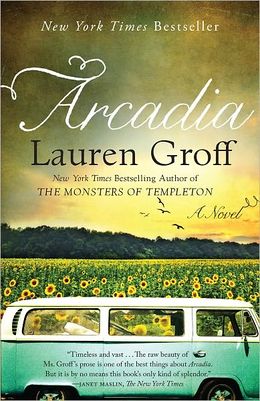
Book Review - Arcadia by Lauren Groff
There are times when I start to read a novel and by the first sentence I am completely hooked, reluctant to put it down and always thinking about the next moment that I will have a free minute so that I can pick it up again and continue to read the story. There are other times when I read a few pages and lose interest, dropping it down on the pile of books on my nightstand, sometimes going back to it on another day, other times just leaving it there until it makes it's way back into one of my book cases. And then there are the times that I start a book, and have a little trouble in the beginning, but keep at it, because I know deep down that it is going to be a gem of a story, one that will hold onto my heart for a long time. Arcadia by Lauren Groff falls into the latter category.
Set in three different periods of time, Arcadia follows little Bit's life, from when he is born into a commune named Arcadia in the late 60's, through his early 30's in New York City and then finally back in Arcadia in his 50's. Born to Abe, a pillar of the Arcadian community, and Hannah, strong and beautiful but prone to bouts of debilitating depression, the only life Bit knows until his early teens is that of Arcadia. A commune based on utopia ideals that works and then falls apart, where everyone works together to create a place where the rules of the outside world are not needed in order to survive. Where music and love and hard work create a home where happiness is meant to be prevalent, and politics, hypocrisy and hatred are non-existent. Arcadia works well in a confined place with a small amount of inhabitants but once it becomes popular the population grows and grows, and the ideals inevitably start to crumble. We see Arcadia through Bit's eyes and hear it's music through Bit's ears, we become part of his life, ask the same questions as him, love his friends the way he loves them and fall in love with the troubled Helle, the girl and then woman who occupies his heart even when he doesn't want her to, when he does. When Arcadia falls apart Abe and Hannah decide to take their son out into the world, before they are crushed by the consequences, and Bit has to learn how to live as most people live, away from the protection of the commune and from the freedom he always knew.
Groff's prose is absolutely beautiful. Her descriptions of Arcadia are stunning and so realistic you can only imagine being there; however, it is the way that she portrays love, heartbreak and pure sadness that really hit me in the stomach. We all know these feelings all too well, but when the prose you are reading actually makes you feel the exact emotions the main character is feeling, down to the very core, something special happens. It's as if it releases something inside of you, a mixture of pure sadness and the realization that you have touched something very beautiful and very clear. I hope that one day my own writing can create the same type of feeling in others, because there is something so incredible about how this type of writing continues to make you feel, days after you have finished the book. Groff has an amazing talent, and I hope she continues to create such wonderful stories for us.
Arcadia is not only a terrific story in itself, it is also, in my opinion, a stunning piece of literature.
Lauren Groff's Website
Monday, September 24, 2012
Book Review: The Marriage Plot by Jeffrey Eugenides
"To start with, look at all the books. There were her Edith Wharton novels, arranged not by title but date of publication; there was the complete Modern Library set of Henry James, a gift from her father on her twenty-first birthday; there were the dog-eared paperbacks assigned in her college courses, a lot of Dickens, a dmidgen of Trollope, along with good helpings of Austen, George Eliot, and the redoutable Brontë sisters. There were a whole lot of black-and-white New Directions paperbacks, mostly poetry by people like H.D. or Denise Levertov. There were the Colette novels she read on the sly. There was the first edition of Couples, belonging to her mother, which Madeleine had surreptitiously dipped into back in sixth grade and which she was using now to provide textual support in her English honors thesis on the marriage plot. There was, in short, this mid-size but still portable library representing pretty much everything Madeleine had read in college, a collection of texts, seemingly chosen at random, whose focus slowly narrowed, like a personality test, a sophisticated one you couldn't trick by anticipating the implications of its questions and finally got so lost in that your only recourse was to answer the simple truth. And then you waited for the result, hoping for "Artistic" or "Passionate", thinking that you could live with "Sensitive", secretly fearing "Narcissistic" and "Domestic", but finally being presented with an outcome that cut both ways and made you feel different depending on the day, the hour, or the guy you happened to be dating: "Incurably Romantic."
I already identified with Madeleine from the first lines. Add some Hardy, Tolstoy, Byron, Rimbaud, Keats, de Nerval and Baudelaire in there and it could have been me. Sitting in a room surrounded by novels that depict love lost and found, heartbreak and happiness within pages and pages of beautiful words has always been my safe place - as it seems to be Madeleine's. Although I feel I am still more pulled towards the darker side, more Hardy and Tess than Austen and Emma. But anyway, am going to try to not to get sidetracked and talk about myself as usual, as I doubt Eugenides wrote this novel with me in mind...
Madeleine is writing her thesis on the marriage plot in 19th century Victorian literature (think Jane Austen's work as a prime example), and how with the changes in society (divorce etc) and marriage not being as important as it once was, the novel itself seems to have slightly lost the plot (so to say). By depicting Madeleine's real life love triangle with her manic-depressive boyfriend Leonard and her friend who happens to be madly in love with her, Mitchell Grammaticus, Eugenides reinvents the marriage plot in it's modern form and gives us a good dose of the modern mixed with the classic, with twists and turns that you cannot even expect to expect, right down to the last page.
Leonard is the one character I so wanted to despise, but just couldn't. Eugenides has a very clear view of what manic-depression does to people, and the picture he portrays of Leonard is one that way too many of us go through every day. (FYI the novel is set in the early 80's, so all of the older terms of this illness and medication are used in the novel). Some times you just want to shake Leonard and tell him to snap out of it, other times you just want him to do the right thing and disappear, leaving Madeleine to live a happier life with someone like Mitchell. Mitchell, on the other hand, is just as lost as the other two, travelling around Europe and India, searching for his spiritual self while pining after Madeleine at every waking moment. Every time you feel like you finally know one of the characters they turn round and show you another side of themselves, just like people in real life. Nothing is ever exactly how it seems and failure to communicate correctly can lead to disastrous as well as spectacular experiences. However many times you think that you know the outcome, it most often doesn't fall quite into place the way you would like it to - which is not always a bad thing. And then sometimes, once in a while, it all just works out perfectly, even if this wasn't what you thought you wanted.
I don't want to talk more about the plot of the novel, as I think everyone will have their own feelings about this, but not only is this a wonderful story, beautifully written, it's also a great psychological insight and social study on how we all react and communicate (or not) with each other on a daily basis. You can protect yourself from everything to avoid pain, but in the end there will always be some cracks in the armour. A serious must-read in my books.
Tuesday, September 4, 2012
Book Review: My Friend Dahmer by Derf Backderf
I had an unexpected night off last night so I decided that an "early" night (meaning around midnight) was in order. I finished this new book off that I was reading and fell asleep... The first few hours of that supposedly "good" sleep were plagued with the weirdest borderline nightmare dreams that kept waking me up. Needless to say the last 5 hours of the sleep (5am - 10am) were just lovely. At first this got me thinking that I just can't have a proper sleep unless I fall asleep after 3am, but then I thought back to another time, years ago when I was a watching a documentary about the same subject as the book I finished last night and had the worst nightmares I had ever had... I suppose I should consider this a lesson: don't read or watch anything about Jeffrey Dahmer before going to sleep. (I guess that would be an obvious conclusion to make).
I've never been a big reader of graphic novels, probably because I never made an effort to read any, and wasn't introduced to any by any of my friends when I was younger (apart from Sambre, the collection that I have written about on here before). A few weeks ago I came across a graphic novel display at the bookstore and was drawn to one that was sitting right in the middle: My Friend Dahmer by Derf Backderf. Of course I had to pick it up. And buy it. I have no qualms about talking about my long-standing interest in the psyche of serial killers. In my teens I wanted to become a criminal profiler and work for the FBI, or the British or French equivalent (I was already aware of the fact that the US government probably wasn't going to hand me a green card just because I wanted to join the FBI). Of course I never became a criminal profiler (probably for the best - I doubt my mind could have dealt with seeing murders and atrocities on an ongoing basis), but my interest in the minds of killers never really went away. I can't really say I am alone in this either - Criminal Minds is one of the most popular shows on TV!
Anyway, back to the subject at hand. Backderf was at high school with Jeffrey Dahmer and depicts his relationship with him, as well as Jeffrey's home life and school life in an awesome graphic novel, recreating the darkness and boredom felt living in a small town, a school where kids grew together in cliques and where there were always different levels on the social ladder. Backderf tries his best to display Dahmer as a person, an introverted and shy teenager with the tendancy to make others laugh with his freakish behaviour. A loner who had no real friends and who had fantasies and urges he couldn't bear to deal with. We see a Dahmer who spends his days drinking behind the school walls, and no one even noticed it, especially not the teachers or most of the kids. Even those who would speak to him never really saw it as something that they should be worried about - they just moved away from him and left him alone. Nothing really shocking about that though - he had no real close friends and his life at home was dire.
There have been so many books and documentaries that discuss Dahmer's horrific crimes and atrocities, but I think this is the first story I have read that tries to show what he was like before he became the serial killer he was. Backderf does not attempt to make anyone feel bad for the young Dahmer, many people have had shitty childhoods and don't automatically turn into serial killers, but he does succeed in giving a monster a human side. Backderf's drawings are perfect for the dark and gloomy Middle America depressed teen story; sometimes reminding me of a dark, graphic version of Dazed and Confused. A coming of age story with a severe nuclear fall-out. The idea of making a graphic novel out of this story is actually perfect - the images are able to display the exact setting and atmosphere of the time and the place that I doubt any words could, and in the end I feel like it makes the story more profound. It didn't make me feel any more sympathy towards Dahmer, but it did show a side that I doubt many people never knew of him, or didn't remember about him. Interesting read, but not something you probably want to read before you go to sleep. I need to explore the world of graphic novels now - I'm sure there are a whole bunch that I will enjoy.Thursday, June 28, 2012
Book Review: Salvage the Bones by Jesmyn Ward
Salvage the Bones takes place over 12 days in August, 2005 in the Mississippi town of Bois Sauvage. 9 days before Katrina hits, the days of the hurricane, and then the aftermath. It's the story of a family of four children and their father, the mother long gone, taken away by death at the birth of her last child. Esch, the main character, speaks in the first person, and the story is mainly hers, spoken from her eyes and mind. Esch is the third child and the only daughter, looks up to her brothers Skeetah and Randall, and looks out for the youngest, Junior. Their father is bringing them up in the only way he knows how, often drunk and often aggressive, but still trying, in his own way. The children are fiercely loyal and protective, and live how they can; Randall intent on getting a basketball scholarship to get him out of the town, Skeetah obsessed with his prize fighter pitbull China and her puppies, Esch wondering how she can keep her pregnancy from everyone and Junior trying to grow up without ever having known his mother.
The father knows that a big storm is heading their way and can feel that it's not going to be like any other storm they have had to face over the past few years. The kids only half listen to their father's fears but help prepare as much as they can, boarding up windows, saving water, buying non-perishable food... When the evacuation call comes in they just put the phone right back down again, as they know there is nowhere else to go but brave the storm at home. But when the hurricane finally hits it is worse than expected, and all of their survival instincts kick in to face the destruction together, as the family they have always been.
The story is heart-breaking, but very realistic: the poverty, the loyalty, the love, the survival and the ability to face destruction and continue with life as you know it, just because there is no other option. The writing in the present tense just amplifies the life in the moment-feel and the way the family lives to survive each day, together, despite whatever they may come across, or whatever comes across them. Amidst the destruction there is still an element of hope that everything will be allright in the end. I literally bawled my eyes out in several sections of the novel, and Ward really doesn't hold back - there are certain scenes where you just want to close your eyes while reading so you don't have to imagine them so vividly. Read this book if you are not scared of reading about real life in the South, because that's what it's all about.
Jesmyn Ward's blog HERE
Sunday, June 3, 2012
Book Review: Half of a Yellow Sun by Chimamanda Ngozi Adichie
I love that moment when you read the first sentence of a book and you know that you are immediately hooked. Your eyes widen, your hands clench the book a little tighter and you feel yourself sinking into the words... That's exactly the way I felt when I opened Half of a Yellow Sun by Chimamanda Ngozi Adichie. I love historical fiction and I am particularly interested in recent African history at the moment, so the fact that this book caught my eye is a no-brainer, but there is SO much more to it than that (more about that a bit further down).
Half of a Yellow Sun is set in Nigeria in the early and late 60's, before, during and a little after the civil war that ensued after Biafra attempts to secede from the rest of the state of Nigeria. Adichie takes us from the independence from Great Britain in 1960, through the military coups that follow, the rising ethnic clashes and violence (specifically against the Igbo) and resulting secession and declaration of independence of Biafra and it's struggle to survive amidst a civil war that breaks out. We follow the story through the eyes and words of five very strong characters: Ugwu, a houseboy who comes to work for the revolutionary university professor Odenigbo; Odenigbo's lover, the beautiful and well-educated Olanna; Olanna's twin sister Kainene; and Kainene's lover Richard, the Englishman who makes his way to Nigeria to write about Igbo art, and falls in love with both the country and Kainene.The story weaves through these characters lives and portrays an image of life in Nigeria before the war: the passion of the Igbo and the creation of their own state, the interactions with life in the villages, life within the urban middle-class and the remaining British ex-pats who keep themselves away from the Nigerian population, hanging on to what is left of the colony days. Adichie provides us with a beautiful story of love, hatred, war, death and humanity (as well as inhumanity).
There is no need to be interested in African history to enjoy this novel, although if you are it is definitely a must-read. Adichie's prose is pretty much sublime in my opinion - she builds such a passionate story line, and develops her characters so intensely well that you are standing there with them all the way, hurting when they hurt, laughing when they laugh, falling in love when they fall in love. My favourite character (after much deliberation) is Ugwu, the young boy who becomes an indispensable part of the family that hires him. I also love Olanna's fierce independence that is coupled with her fear of losing everything she loves... Each character is completely human, imperfect and real, I feel like there is a part of everyone in all of them. There are many difficult parts, specifically the descriptions of massacres, rape, death and starvation, but all are important in understanding the complexity of the situation and the passion of the people to be free of outside, controlling power.
I cried a lot reading this book, and it probably wasn't a good idea to finish it on my subway ride back home last night, with tears running down my face; and many a time I felt like I was being punched in the stomach, but all the same, I couldn't stop reading. I could literally see and smell the country through the words, and this is something that I admire so much in a writer - the ability to really create a world that I have never seen before right before my eyes. Adichie is only a year older than me, and I feel like she has created a beauty of a novel, set in very disturbing times. I can't wait to read her first novel, Purple Hibiscus, and her collection of short stories, The Thing Around Your Neck. So very inspiring.
More information:
Chimamanda Ngozi Adichie's website
Thursday, May 10, 2012
Book Review: The Red Leather Diary by Lily Koppel
I still have all of my diaries that I have kept over the years, the first one being from when I was 10 years old if I am not mistaken. Over the years I see changes in handwriting, developing ideas, crushes and heartbreak, drawings, sadness, happiness. Some of the journals are full, others conclude halfway through with a sentence along the lines of "this is the end of this part of my life and therefore a new journal is to be commenced". I still keep a journal, at 34, but today it is more of a scrapbook than just writing, snippets of sentences created by emotions and visions, photos, drawings, concert tickets, notes from friends, lists and so on. I love rereading entries from years ago, but I doubt they really would be of any interest to anyone else. Except of course if I become a world famous author, because then, after my death, scholars will devour my teenage thoughts to try to figure out who I was, just like I did when I was writing my thesis on Sylvia Plath.(Yes, yes, one can dream).
I love reading the journals of famous artists. Not because I want to actually determine who so and so actually is, but because they always contain a deeper view into feelings and thoughts and emotions, and also because they often contain some of the best writing. One writes a journal with the knowledge that it is not going to be read by anyone else, so therefore one allows oneself to be more free and open. That's the way I see it anyway. For example, Sylvia Plath's unabridged journals may contain some of the darkest prose that she had ever written, in my opinion it also contained some of the best.
What would you do if you were a budding journalist and one day came across a five year journal, started by a 14 year old living in Manhattan in the 1920's? You would probably read it, and then see if you could get it published in some way or form. Lily Koppel went a few steps further than that: she read it, went on a search for the author, and once she found her, rewrote those five years in her own words, interspersing the prose with snippets from the journal itself. Early in her career with the New York Times, Koppel was leaving her apartment building one morning when she came across a dumpster containing trunks dating back to the previous century. The building management had decided to get rid of content that previous residents had left in the basement and never come back to collect. Can you imagine getting a chance to go through such treasures? Old photos and clothes and books and letters and ornaments and hats and cards and maps! I would have had a field day! The red leather journal was found in one of those trunks and belonged to a young lady called Florence Wolfson.
Florence was a smart, fashionable, precocious teenager, with many interests, mainly in the usual pursuits of the young, love, sex, friendship, as well as the world of Art that the city of New York had to offer at the time. She wrote of books, plays, actors and actresses, poems, paintings, and focused a lot of her own time on writing and drawing, as well as going to performances and other activities such as tennis, fashion and parties. Her journal portrays a woman of her time, as well as a glowing Manhattan of the late 20's and early 30's (including mentions of the more darker times after the Wall Street Crash of 1929). I was first drawn to the book after reading the cover because I wanted to delve into the life of a teenager in the city during the 20's, but once I started to read the book it was Koppel's wonderful writing that really drew me in. Koppel has the ability to recreate a life lived so long ago into a story of such tenderness and beauty that I was brought to tears in several different parts. For a time I felt like I was actually living right by Florence, and imagined my own teenage life side by side with hers. The beauty of this book is that Koppel added a part of herself into Florence's life, giving us readers the chance to do the same.
Inspiring, to say the least.
More information on the book and the author HERE
Thursday, May 3, 2012
Book Review: Patti Smith - Just Kids
I own this book in it's beautiful hardcover edition and recently acquired a paperback copy, courtesy of a friend. Said paperback copy was read within 24 hours (one should probably say devoured) and marked up with my own scrawling notes in French. I feel sorry for the person who is currently reading this copy, as they are probably getting distracted every other page, trying to decipher what my notes mean in comparison with Patti Smith's text. Maybe the next reader will add his/her own comments, and bit by bit, my copy of the book will be filled with the feelings the text evoked in others? Sounds like a pretty interesting idea actually...
I've always loved Patti Smith. I've seen her perform multiple times, love her writing, her music, her personality, just everything about her. A few years ago I went to a very small venue to see Karen Elson perform and nearly had a heart attack when I realised Patti Smith was standing right next to me. Like 5 centimetres away. I told her psychically (i.e. my brain sent out a message) that I adored her, because there was no way I was actually going to be able to say that out loud. Maybe she heard it, maybe she didn't. In any case, I love her. I think I was drawn to her at first because of her very healthy obsession with Rimbaud, which is very similar to my own very healthy obsession with Rimbaud. But I had no idea how similar a lot of my interests at the age of 19 were with hers, many years before that, when she was 20 and moved to NYC.
Just Kids is Patti Smith's tale of her story with Robert Mapplethorpe, how they met, how they grew close, their relationship, their life together, amidst the world of bohemian art and music in the late 60's and the 70's in New York City. The way she describes the New York she lived in is the same as the one I imagined growing up, a paradox: gritty but blooming, urban but bohemian, dangerous but safe at the same time, ugly but beautiful... One of those places where anyone and everyone, no matter what your background, interests, faiths or nationality is, can go and blend in and find other people just like them. I don't think that from this standpoint the city has really changed (although it is probably a lot safer than it was in the 70's and the 80's). Patti's New York resembles my own New York, a place that could have been my downfall, but ended up being my home.
Patti arrives in New York without an idea of what she is really doing there, practically lives on the streets, roaming around, and finds Robert, and both become inseparable, pushing each others boundaries within the world of art and within their own world, a world created amidst dreams and reality. Patti's writing has always been poetic in nature, even her songs are first and foremost poems that work insanely well with music. There is something so innocent and wonderful about her relationship with Robert, even when she describes the days when they are without money, Robert's obsessions with displaying his darker sides through his art, their break up and all of the other obstacles that pop up along their journey together. I think the most beautiful part of the whole story is the love that they have for each other, something that everyone in this world (I hope) can relate to. Everyone wants to have a Robert or a Patti in their lives, and if you have one, cherish him or her.
When I was 19 my best friend Maud and I decided to go on a trip to Paris. It was only three hours away from Grenoble on the TGV, but a huge deal for us because we were going to be able to walk along the quais of the Seine together and visit all of the sites that we had read about in our books. Our obsession with Gérard de Nerval was so huge that we did a lot of research into finding the exact spot where he had died, so that we could visit it ourselves (the exact street does not exist anymore if you are interested). When I got to the part in Just Kids where Patti makes her way to Paris and describes how she went on a search to find the spot where Gérard de Nerval used to drink I nearly burst into tears. Gérard de Nerval! My absolute favourite French poet and writer. When she describes how Robert introduced her to Tim Buckley and Tim Hardin I literally did start crying, as these were my own father's favourite singers, and he introduced them to my mum who introduced them to me. But it wasn't just these random occurrences that made me feel so close to Patti, it was just the way her mind worked at the time, how she would react to certain situations and how shy she would feel around people and at the same time how she wouldn't hesitate to speak her mind, whether it verbally or through some form of art.
I haven't read a book where I relate so much to one of the characters in a while, and this was all the more powerful because Patti is real, and really did live through all of this. I'm sure many other people relate to her just as much as I did and still do, but what I found the most interesting was that I felt like my 19 year old self again when reading the book: well-read, shy, obsessed with 19th century literature and music, sad but happy, full of poetry and ideas and living a different lifestyle to most of my peers (apart from the group of friends I had with similar aspirations). I'm so inspired again right now. Patti's tales of how she dressed and how her and Robert would search for the right outfit for the right occasion, are so spot on, tell of a time and a place but are also completely timeless. Robert also took some stunning pictures of Patti - I actually really want to get some prints of his portraits because they are really good.
I love the fact that Just Kids mostly tells of Patti and Robert's days before they became famous, and contains a fuzzy, fairy-tale type aura around it. It remains somewhat innocent and happy, despite some of the more difficult times depicted in the narration. I also wish I had the copy of the book I had annotated now, because I had made some comments that I am sure should be in this post write now. Probably something about paradoxical decadence, or another one of those phrases I used to bandy about when I was a teenager. So there you go... Paradoxical Decadence.
Read Just Kids. It's absolutely wonderful.
Patti Smith Website
Friday, April 20, 2012
Book Review: Sold by Patricia McCormick
Those of you who regularly read this blog know that I focus a lot of my attention on what is going on in this world, with a particular focus on atrocities committed towards women and children, mainly trafficking, mass murder and genocide, rape and the recruitment of children to become soldiers. I real a lot of writing concentrated on these topics, both fiction and non-fiction and try to review the ones that touch me the most on here. For every story told, there are millions of others to be heard, and, in my opinion, these stories cannot be heard enough.
A few years ago I reviewed a book called The Blue Notebook by James A. Levine on here, the story of a young Indian girl, sold by her family into child prostitution. Today I picked up another book in the same genre, Sold by Patricia McCormick.This is a story of a young Nepali girl called Lakshmi, who, after her stepfather has gambled away all of the money her family has earned with their meager rice paddies, is sold into sexual slavery in India. During her time in the brothel she learns what the meaning of evil is, but also that where evil prevails, good can also be found. The novel starts with Lakshmi describing her less than idyllic life in Nepal with tenderness, and then descends into the pits of what becomes her own personal hell as a child prostitute. At times beautiful, but mainly heartbreaking, all you want to do is jump into the book, wrap Lakshmi in her shall and carry her away with you into a world where no one else can harm her.
Written in a simple, but very lyrical prose, that often comes across as poetry, McCormick creates a story told from the eyes of a young, innocent girl, forced into the heart of of disgusting trade that continues to happen all over the world. This may be fiction, but it comes from reality, and McCormick did a lot of her research on the topic by traveling to India and Nepal, interviewing the victims, traffickers and people who have created shelters for the victims. I don't know how to answer the eternal questions of how people can sell their own children into slavery, how grown men can pay for sex with mere children and not even question their actions, and how grown women can enforce this in the brothels. But I do know that there ARE ways to help stop this, and hopefully, one day, this can all be somehow outlawed. Yes, still the idealist at heart, but without hope I don't know how I could live.
While I am on the subject of women, children, India and shelters, I will be helping my friend Theresa VanderMeer who I interviewed a while ago on here this weekend at the NYC Green Festival at Javits Center North.WORK+SHELTER will have a stand at the festival so come visit if you are around.
Some more information on the novel, and further links on the topic:
Patricia McCormick official website
ECPAT-USA
Vital Voices
Amnesty International
Monday, March 26, 2012
Book Review: Dance the Eagle to Sleep by Marge Piercy

There really is something about Marge Piercy and her writing. She literally TALKS to me. I've already talked about how much her novel Gone To Soldiers has affected me in my life (as well as the sheer amount of times I go back to it), but she has written other novels that have the same effect on me. Her prose tends to tear me apart, touches me intensely and then leaves me to think about it over and over again for days afterwards. A lot of it comes from the fact that she is able to to create story lines around (political) ideas that I completely agree with; strong characters that you relate to, love, dislike, want to be; and her powerful writing that always seems to become timeless. The ability to blend beauty and ugliness together in prose is what Piercy is insanely good at, as well as the ability to make you imagine that you are living the exact story that you are in the middle of reading.
Dance the Eagle to Sleep is Marge Piercy's first novel, originally published in 1970 and recently reissued, with a new foreword by Piercy herself. The novel is centered around four students, each from different backgrounds (Shawn the rockstar trying to avoid doing military service, Joanna the runaway, Corey the revolutionary and Billy the scientist). The story starts with the student revolt at Franklin High and continues with the development and country-wide growth of a dissident youth movement named the "Indians". Young people who are tired of being told how to live their lives, what they need to become to be a "proper adult"and what box they need to fit into. People with ideas that defy the norm and who want to live, be free and create a new type of world where there is no war and plastic pre-fab lives and boredom.
Through-out the novel the movement grows inside and outside of the cities; communes are created and the inevitable governmental crackdowns start happening. The Indians become self-sufficient and live as one large family, with natural leaders and different groups inside the family. Discussions are held every day where all members can voice thoughts and opinions and drugs are seen as a way to enlightenment as opposed to addiction, in the same way as hallucinogenics were used in certain Native American tribes. The Indians look for peace in the alternate way of living but prepare for the eventual clashes with the police and the the government. Police brutality is expected, but once the violence of the crackdowns becomes more akin to war, the family divides into those who want to go underground and those who want to fight to the bitter end.
Although an invented world, this novel is never far from the truth, and is based on the student protests in the 60's, and can easily be transplanted into the world of today, with the Arab Spring and the Occupy movement around the world. Hope, change, revolution, repression. A story of despair, of hope, of uprising and of defiance. Full of powerful images and metaphors that leave you imagining the may bes and the could have beens.
Marge Piercy's Website
Sunday, March 4, 2012
Book Review: Let The Great World Spin by Colum McCann

Let The Great World Spin by Colum McCann
I just finished this one on the subway home from work, after starting it yesterday. I have to write about it now, even though I have a million things to do to prepare for my trip to England on Tuesday morning (working 8 days in a row and then picking up an extra shift tomorrow night isn't giving me much time to do laundry, pack, clean the apartment, go to the bank, print the eulogy and my tickets etc etc). I just have to write about this one now because I want to do it while it is still fresh in my mind.
No wonder this novel won the National Book Award. It's AMAZING. The story is about several lives that are intertwined in NYC in the 70's: Corrigan and his brother Ciaran, Irish immigrants living in the Bronx, Tillie and her daughter Jazzlyn, two prostitutes in the Bronx that Corrigan looks after, Clare and her husband Solomon, parents who are mourning the untimely death of their son in Vietnam, Lara and her husband, artists who are still looking for themselves through art and drugs, as well as quite a few others, lesser characters, but just as important and interesting.
Colum McCann starts the story with Philippe Petit's incredible feat of walking between the Twin Towers on a cable, and proceeds to use this as a back story for all the entire book. On the day that Petit walks across the wire different events happen that will change the lives of all characters for the rest of their lives. Although the narrative goes back in time and into the future to give background on some of the characters and events, the main storyline is based in this week in August 1974.
Rich, full of emotion and feelings that everyone can empathise with, this book is literally magical. Not only that, it creates a real vision of NYC, one that really exists, a city of everything, paradoxical and alive, one that anyone who has lived in NYC will immediately recognise. It's going to take me a while to get this book out of my mind, I think I am still a little overwhelmed.
At the end of the edition I read there is an interview with McCann by Nathan Englander. One of the questions was "Let The Great World Spin paints a broad picture of New York. Do you want to talk about the various worlds you walk us through?". McCann's answer really does explain it all, and I have to say that he succeeded in what he set out to do: "I wanted it to be a Whitmanesque song of the city, with everything in there - high and low, rich and poor, black, white, and Hispanic. Hungry, exhausted, filthy, vivacious, everything this lovely city is. I wanted to catch some of that music and slap it down on the page so that even those who have never been to New York can be temporarily transported there."
Read it - you won't be sorry.
Colum McCann
Man On Wire - Philippe Petit documentary
Saturday, March 3, 2012
Book Reviews: Thirteen Reasons Why & The Fault In Our Stars

And couldn't stop. Thirteen Reasons Why (by Jay Asher) tells the tale of a high school kid called Clay who receives a box of cassette tapes in the mail. No return address and no sender. Once he starts to listen to the tapes he realises that they come from a girl called Hannah, a girl who had committed suicide a few weeks before. Through her voice on the tape he learns the reasons why she killed herself. It's heartbreaking, but so very real. The narration is shared by both Clay and Hannah's voice on the tapes, Jay Asher actually does a wonderful job weaving the narration seamlessly. You actually don't feel like the story jumps between the character's voices, more like there are two voices complementing each other, both sides of the story coming together as one. I actually wish I had read this book as a teenager, and would probably advise all teens to read it. It's so sad, but the story does show that all actions, however small they may be, can have consequences.

So I raved about the book to Holly and she came back with three more, one of which was The Fault In Our Stars by John Green. I started it yesterday during the performance at work, spent 2 hours reading in bed before I literally couldn't keep my eyes open anymore and got up early to finish it this morning (and I am dealing with serious sleep deprivation this week). This story deals with life-threatening illness (cancer) in teens. What I liked about this book is that it treats cancer in the way that cancer victims live through/with it, and avoids all the clichés that you may expect. The main character, Hazel, is smart, funny, witty and lives with the fact that one day in the near future she will not be around anymore. John Green creates a wonderful story with characters you just can't help falling in love with. Imagine the shit you went through as a teen, and then imagine having cancer on top of that... It's like trying to live as a child, a teen and an adult all at the same time. And yes, you will cry, but you will also laugh just as much.
I also must mention that it's pretty awesome, having a friend like Holly who has the knack of picking out the exact book you need at just the right time <3
Saturday, February 25, 2012
Book Review: Displaced Persons by Ghita Schwarz

I'm still obsessed with historical fiction, and will always make a beeline to any fictional writing based in the 1930's and 40's. World War Two still holds a fascination for me that I can't explain. I go for non-fiction too, but fiction will always be my main love. There is something about the fact that it COULD be real, because the written story will be based on events that actually happened at some point in time. It helps me imagine myself in the feet of the characters, living the lives that they did, thinking that maybe they did really exist, or someone like them was alive at the same time in the same area. All that to explain that my purchase of Ghita Schwarz' Displaced Persons was yet another random buy that I happened to come across when browsing the through the new book selection at St Mark's Bookstore. WW2 + Europe + survivors? It was a no-brainer, I grabbed it and immediately started reading it.
The story starts in 1945, just after the war and follows a small group of "displaced persons", the name given to concentration camp survivors and general survivors of the Nazi murdering machine, as they randomly find each other and fight to rebuild their lives as best as they can. The main character through the book is Pavel Mandl, and the narration follows him through his life, directly post-war around the Belsen camp and then post-immigration to the US with his new family and friends. The story sometimes skips to other characters, for example Fela, Pavel's wife; Chaim, the young boy who had survived the Holocaust by pure wit and intelligence and attached himself to Fela and Pavel, and Sima, Chaim's wife. You can find a full synopsis of the novel HERE.
I like that this book was written about survivors picking up the pieces and creating new lives for themselves, after losing everything, instead of being about the actual survival during the war. The narrative is written in such a way that you can hear the Yiddish, Polish and Russian inflections in the characters' voices, but it's so well done, that you don't even notice it outright, it just seems natural. The other point that I really liked about this book is that Schwarz focuses on the characters as normal people who have gone through traumatic experiences and continue to be normal people looking to survive and move on with their lives. The fact that they are survivors does not make them into super humans, they are just normal human beings with flaws and hopes and dreams, trying to make the most of what they have, while still trying to come to terms with the tragedies they have experienced.
By the end of the novel you feel as if you have known the characters all of your life and you don't want to leave them. I applaud Schwarz for writing such an emotional and real novel. If I am not mistaken this is her fictional debut so I can't wait to see what she comes up with next! I also LOVE the fact that she added a couple of pages to the end of the novel with titles of books about the subject, as well as a small synopsis for each book. For someone like me who continues to look for WW2 fiction, this is the best thing that an author can do!
More information:
Gita Schwarz official website
Monday, February 6, 2012
Book Review: They Poured Fire on Us From The Sky: The Story of Three Lost Boys from Sudan

We have all heard stories of war and famine in Sudan on the news, especially over the past year as the famine has been widespread, extremely deadly and finally people have started taking notice (for a little while anyway). The North and the South have now become two separate countries and hopefully South Sudan will now be able to create an environment of peace again after so many years of war, mass killings and atrocities committed by both the government of the North and rebel army fractions from the South. Children have literally grown up in refugee camps after fleeing for their lives and managing to survive alone, through great hardships and without their families. I'm not going to go into detail on the decade-long conflict here, but there is more information on the country HERE.
During the years of war, millions of boys (and girls) from the ethnic Southern Dinka and Nuer tribes ran for their lives when their villages were attacked, walked thousands of miles over years through famine, desert, starvation and death, and survived. About 20,000 or so of these boys (and much fewer girls) ended up in refugee camps in Kenya and Ethiopia. These boys were colloquially named the Lost Boys of Sudan, and the name stuck. More information on the Lost Boys and literature regarding them HERE. The 20,000 refers to only the boys who survived and ended up in refugee camps, the numbers of displaced children go into 2 million or so, so many dying before they could ever reach safety.
I literally could not stop reading They Poured Fire on Us From The Sky. It accompanied me everywhere, until I finished the last page yesterday and felt a little at a loss on what to read next. What can follow on after such a heartbreaking but heartwarming book?! The book revolves around the true stories of three of the Lost Boys of Sudan, told in their own words after their arrival to the USA in 2001. While in a refugee camp in Kenya they applied to the program set up by the US government and the UNHCR to have a certain number of lost boys (and girls) resettle in the USA.
Benson, Alepho and Benjamin are brothers and cousins from the Dinka tribe of South Sudan, born into villages where they spend much of their time helping their families by guarding cattle from a young age. When war broke out and their villages were attacked they literally fled for their lives, with just the clothes they were wearing. For years and years they ran, across southern Sudan, to Ethiopia, back to Sudan, and finally all ended in refugee camps in Kenya. They lost each other many times, but miraculously found each other again, on multiple occasions. Each chapter is written by one of the boys and recounts a story, an occasion, or a memory of something that happened along their journey. Atrocities, death, starvation, wild animals, bombs and so many tears, but also hope, love and at utmost will to survive.
I honestly could not even imagine my 5 year old self trekking across thousands of miles of bush and desert, running away from death without knowing if I was actually going to run right back into its jaws again; not knowing if I would ever see my family again, whether they were alive or dead. How they survived all those years seems pretty much like a miracle to me.
Buy and read this book, you will cry (unless you are really heartless), and it will break your heart, but it also may open your eyes slightly, if they aren't already wide open enough.
More information on the book and the authors HERE.
Tuesday, January 31, 2012
Book Review: Jennifer Egan's A Visit From The Goon Squad
A Visit From The Goon Squad

I bought this book last year in the summer, when I was in Santa Cruz with my sister. I had seen it around in every book shop, picked it up, read the back, hesitated and then put it down again. I finally bought it because it really did look like something I should read, and would possibly like. I only picked it up to read it recently because I am trying to get through my "to be read" piles of books before purchasing any new ones. As soon as I started reading the book I recognised the style and realised that I had already read another book by her a few years back (The Invisible Circus), which I hadn't been able to put down.
This is one of those books that I wish I had written myself. You know, when you are reading it, you stop and say "ARGH - I wanted to do something like this!!". Yes, that. Each chapter is written from a different person's standpoint, from a different type, but everyone is linked back to everyone else, brother, mother, sister, father, son, daughter, employer, friend, boyfriend, girlfriend. Spanning 30 or so years, and seemingly disconnected while each chapter jumps to another character and time, the storyline is held in place by a string of music. By that I mean that music is the underlying theme in each chapter and that everything is brought together by music. From the kids in the LA punk scene, via the music label guy who won't sell out to the last concert at the end of the book 10 years from now, music is literally everywhere. Of course I was going to love this book!!
I read a few reviews last night after I had finished the book, and was surprised to read that many people felt they couldn't connect with the characters as I felt a lot of affection for most of them, especially Sasha and Rob. Other people complained about the whole PowerPoint pages nearer the end of the novel - I thought it was a pretty genius way of telling a story, especially seeing as the point was to show how music and structure can help calm the symptoms of autism. Others complained that it didn't deserve the Pulitzer, but then again didn't really give any reasons for why it didn't deserve it. All I can say is that I devoured the book, and I haven't done that for a while. It's quite refreshing to say that because I've been a little disappointed by what I have been trying to read lately.
I cried in the end. I don't want to spoil it for anyone, so I won't really say anything, but the ending is pretty majestic in my opinion. High technology and simple feelings, all brought together by music that everyone knows. Brilliant.
Tuesday, January 3, 2012
Marge Piercy's Gone To Soldiers: my favourite book of all time

This happens once a year, at least once, sometimes multiple times: all of a sudden I will stop what I am doing and say "it's time to read Gone To Soldiers again." Then I pick it up and fall back into the words that have kept me going for so many years now. I will never ever tire of this book. It happened to me this morning, while I was making my morning tea, wondering through the haze of my mind what on earth I was going to write about today, trying to avoid the inevitable subjects of "2011 was a shitty/great/annoying/interesting year", when I just stopped in my tracks, grabbed my most recent copy of the book and read the first page. Nothing better than starting off your new year with firstly your first bender in 3 years, and then back to reality with your favourite book. The former not to be revisited for a while, the latter a lot more healthy.
The first time I read Marge Piercy's Gone To Soldiers was in 1991 or 1992. One of my mum's friends lent it to her, and as with any book that ever came into our household, I read it. Actually I devoured it. I've always loved historical fiction, especially dealing with WW2, and I love strong women characters that I can relate to. I also love rich, well-constructed prose, words that let you imagine the scene in your own head, help you to picture faces and expressions and leave them imprinted in your mind for a long time after you have read the last page of the book. This is how Marge Piercy writes. Gone To Soldiers will make you laugh, cry, want to hit things and finally feel like you can go out and accomplish anything that you want to, just because you can.
The novel is the story of ten different characters (men and women), interweaving, across the Atlantic and the Pacific, over the space of 5 years of war. Every character is human, and you will probably relate more to one over another, depending on how old you are when you read the book. My favourite will always be Jacqueline, feisty French Jewish girl who has to grow up and deal with the undealable. I sometimes see some of myself in her, more than in any of the other characters. Basically, Jacqueline makes me realise how much potential we have to create something from our lives, while remaining true to our hearts and beliefs. I know it sounds a little silly said like that, but you really need to read her story to understand what I mean.
There is also Bernice who breaks away from her father and runs away to fly aeroplanes; Louise who goes from writing women's stories to writing from the front lines in France via London; Daniel who deciphers code for a living; Jeff, the artist with the survival instinct, and probably the male character who I am the most attracted to; Abra who learns to live with nothing after having everything and all of the others who will touch your lives in a way that you wouldn't expect. An epic story that you can't put down. Life changing? Maybe. Just read it, the least it can do is help you learn a little more about what the regular person went through in the 40's.
I've read this book at least once a year since 1991. I've been through so many copies of it, I've given copies to my friends and it is without a doubt my favourite book of all time. Every time I read it I discover something new and somehow I find comfort in the stories, in a way I find a patch of non-moving ground that I can stand on for a moment to recollect myself.
More information on the book on Marge Piercy's website: Gone To Soldiers
More information on Marge Piercy: Biography
All of Marge Piercy's novels are excellent - once you have read this one try the others (especially Braided Lives).
Saturday, October 22, 2011
Anthropology of an American Girl - review & musings

I find it very, very difficult to categorise books. There are books I liked, there are books I loved. There are books I really didn’t enjoy but forced myself through anyway. There are books that I couldn’t get into, but went back to after months, even years, and loved. There are good books that I didn’t enjoy. There are books that are not considered “good” that I really loved. I read for several reasons, the main one being because I cannot remember a day in my life when I haven’t been reading one book. The other reasons are completely self-explanatory: I read to learn, to escape and to let my imagination run away from me. I am never bored, not just because I always have something to do or to see, but mainly because I always have a book to discover, to read, to finish. I live surrounded by books, as do/did my parents and my grandparents, my sister and my brother. I read fiction and non-fiction, classics and modern fiction. I love poetry, plays and prose. I love to read poetry out loud to my cat (she prefers French literature to English, but I think that is more because of her national pride and all that). Words inspire me, reading inspires me to write and vice versa.
I read many books that inspire me, I read many good to very good books, but there are only a few times a year that I read a book that hits me so deeply that it affects my entire being for the time I am reading it, as well as afterwards. I read a review of Hilary Thayer Hamann’s first novel Anthropology of an American Girl a while ago, and tried to bookmark it in my brain, but didn’t remember about it until I was browsing the new paperbacks at St Mark’s Bookshop a few weeks ago. Once I started it I went back to the Jade I was when I was 17 and 18. It’s as if I had a direct connection with the main character, Eveline Auerbach. I am probably not the only one who feels this way, but I am not kidding when I felt I was being literally pulled into the story and became Eveline. First love, second love, heartbreak, freedom, passion, thoughts… The last years of high school, growing up in a “bohemian” household, friends who know your fears and help you through them, fragility but so much strength. But then, halfway through the book Eveline and I became separated. We went our separate ways, she took a path I could not agree with, could not really understand, while I took another path, that of personal freedom from everything.
There is a very specific break in the story, between high school graduation and the beginning of college and it was at this point that Eveline and I became friends and I no longer saw her life through her eyes, as one, but by her side, through her narration.
To understand, you must read this novel. On the outside it appears to be another coming of age novel, girl becomes woman, loves and loses, to love again, but there is so much more to this than that. The prose is wonderfully well written, so much that instead of reading you feel that you are living the story. When Eveline was sad, I cried. When Eveline was depressed, I walked around in a haze. When Eveline walked away I threw the book on the ground in anger. What I am trying to say is that Hilary Thayer Hamann did a remarkable job of writing a novel that is right up there on my favourite novels that I will read over and over again and that will never cease to make me cry list. Right up there with Marge Piercy’s Gone To Soldiers, Sylvia Plath’s The Bell Jar, Thomas Hardy’s Tess of the d’Urbervilles to name a few. We go through Eveline’s late teens and early twenties, follow her from East Hampton to Manhattan, watch her grow, then wither, then grow again.
We all have an Eveline, a Harrison Rourke, a Jack, a Kate, a Rob and a Mark in our lives, whether we are male or female, they all exist. I know who they are in my life. At first I thought I could be Eveline, it appeared that I am not, but I still love her as a person. Person or character? Although the main character is female, the story is for everyone. Be prepared to be punched in the stomach and in the face, to bawl your eyes out and to want to run to the ocean and watch the waves. Just read this book – you won’t regret it.
(When I bought the book I thought I was giving myself a break and that this was going to be some fun, light reading. I was so wrong! I didn’t realize exactly how much it had affected me until I found myself crying at everything this week, even for my crying average it was over the top. For some reason this story just hit me right in the core).
“Everywhere there are angels.”